

Subscribe to AccessBit Newsletter
Accessibility

TL;DR
- Web accessibility is not just about meeting legal requirements. It is a business strategy that helps companies grow.
- An accessible website can reach more than one billion people with disabilities and many others who benefit from inclusive design.
- Accessibility improves search engine visibility because search engines and AI systems prefer well-structured, easy-to-understand websites.
- Better usability helps more visitors complete purchases, fill out forms, and engage with your business, leading to higher conversions.
- Inclusive digital experiences build customer trust, improve brand reputation, and encourage long-term loyalty.
For many years, web accessibility was viewed mainly as a legal or technical requirement. Businesses often made accessibility improvements only when regulations required them or when they wanted to reduce the risk of legal complaints. This approach treats accessibility as a task that needs to be completed once and then forgotten. While this may help a business meet the minimum legal expectations, it does not allow the business to enjoy the full value that accessibility can offer.
The digital world has changed how customers interact with businesses. Today, people search for products online, compare prices, read reviews, book appointments, and complete purchases through websites. Every visitor who arrives on a website is a potential customer. If that visitor cannot read the content clearly, navigate the pages easily, or complete an important action, the business may lose an opportunity without even realizing it. Accessibility removes many of these barriers and helps create a smoother experience for all users.
This change in perspective is important. Instead of asking, "What is the minimum we need to do to stay compliant?", businesses should ask, "How can accessibility help us serve more customers and improve our digital experience?" The second question focuses on growth rather than obligation. It encourages businesses to build websites that are useful, welcoming, and easy to use for a wider audience.
When accessibility becomes part of a business strategy, it supports several areas of growth at the same time. It helps businesses reach a larger market, improves search engine optimization (SEO), increases conversions by making websites easier to use, and builds trust among customers. Lower legal risk is still an important benefit, but it becomes one part of a much larger business advantage. Companies that understand this difference are more likely to see accessibility as an investment that continues to deliver value over time.
The Business Case at a Glance
Instead of solving only just a problem, accessibility always helps with supporting different parts or areas of a business. Below is a quick table that shows how accessibility contributes to the growth of a business.
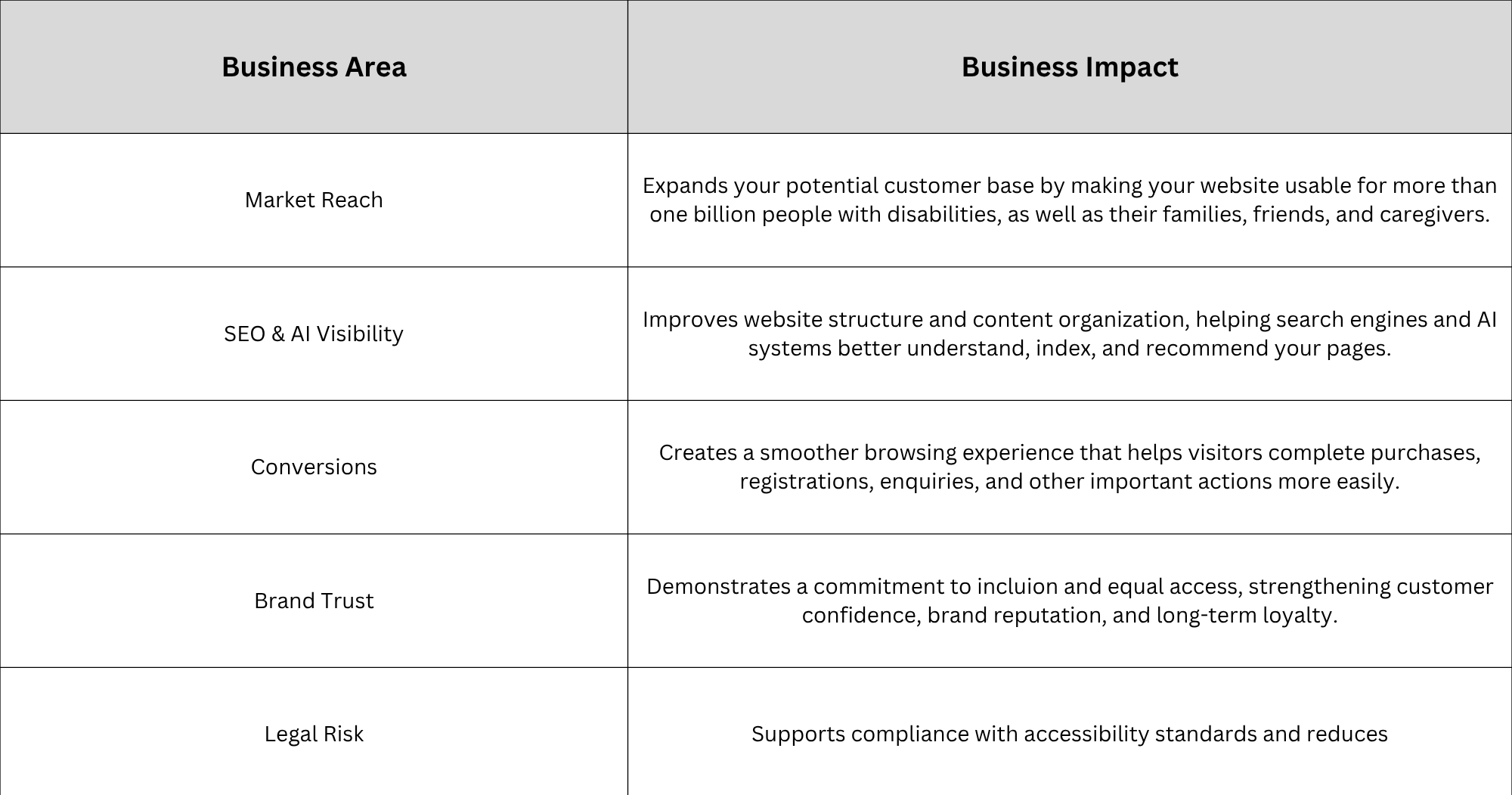
The important point is that accessibility does not improve only one business function. It supports marketing, customer experience, website performance, brand reputation, and legal preparedness together. This combined impact is what makes accessibility a valuable business decision rather than just another compliance checklist.
The 5 Ways Accessibility Drives Business Growth
1. Accessibility Expands Your Market
One of the biggest web accessibility business benefits is the ability to reach more customers. More than one billion people around the world live with some form of disability, making them one of the largest consumer groups. Their spending power, together with that of their families, friends, and caregivers, represents a significant global market. If a website is difficult to use, many of these potential customers may leave before exploring products or services, leading to missed business opportunities.
An accessible website removes these barriers by making information, navigation, and online services easier to use. This allows more people to browse products, complete purchases, or contact the business without frustration. Instead of limiting your audience, accessibility helps your business connect with a wider range of customers. Expanding your reach in this way not only supports inclusion but also creates new opportunities for growth and long-term customer relationships.
2. Accessibility Improves SEO and AI Visibility
Many businesses wonder, does accessibility help SEO? In many cases, it does. Accessibility encourages the use of clear headings, descriptive links, alternative text for images, and semantic HTML. These elements help people using assistive technologies understand your website, while also making it easier for search engines to crawl and index your content.
The same practices also support AI-powered search experiences. AI systems prefer content that is well organized and easy to understand, making accessible websites more likely to appear in search results and AI-generated answers. While accessibility alone will not improve rankings overnight, it provides a strong technical foundation that works alongside good content and SEO practices to increase your online visibility.
3. Accessibility Improves Conversions for Everyone
Getting visitors to your website is only part of the customer journey. The next step is helping them complete an action, such as making a purchase, submitting an enquiry, or signing up for a service. Accessibility supports this by creating a smoother and more user-friendly experience. Features like readable text, simple navigation, clear forms, and keyboard-friendly controls reduce confusion and make tasks easier to complete.
This is often called the curb-cut effect, where features designed for one group end up helping everyone. For example, captions help people with hearing loss, but they are also useful in noisy environments. High colour contrast benefits users with low vision while also improving readability in bright sunlight. When more visitors can use a website comfortably, businesses often see better engagement, lower bounce rates, and higher conversion rates.
4. Accessibility Builds Brand Trust and Loyalty
Customers remember businesses that provide positive experiences. When a website is accessible, it shows that the company values inclusion and wants every visitor to have equal access to its products and services. This creates a positive first impression and helps build trust, especially among customers who appreciate businesses that consider different user needs.
Trust often leads to loyalty. Visitors who can easily use a website are more likely to return, recommend the business to others, and become long-term customers. In competitive markets where products and prices may be similar, a better user experience can become a key factor that sets one brand apart from another. Accessibility therefore strengthens not only usability but also the overall reputation of the business.
5. Accessibility Reduces Legal Risk
Meeting accessibility standards helps businesses reduce the risk of complaints and legal action related to inaccessible digital experiences. Many countries now have accessibility regulations, and businesses are increasingly expected to provide websites that can be used by people with disabilities. Addressing accessibility early is often easier and less expensive than making major changes after legal issues arise.
However, legal protection should be viewed as an added benefit rather than the main goal. Businesses that focus only on compliance usually make the minimum required changes. Those that treat accessibility as part of their digital strategy gain much more, including improved customer experience, stronger SEO, better conversions, and a wider audience. In the long run, this growth-focused approach delivers far greater value than simply avoiding legal risks.
How Accessibility Actually Boosts SEO and Conversions
It is easy to say that accessibility improves SEO and conversions, but it is equally important to understand how it happens. The connection is not based on one feature or one ranking factor. Instead, it comes from a combination of improvements that make websites easier for both people and technology to understand.
Search engines work by reading and organizing information from webpages. They rely on headings to understand page topics, descriptive links to understand navigation, alternative text to understand images, and semantic HTML to understand the purpose of different page elements. Accessibility encourages businesses to follow these same practices, making it easier for search engines to crawl and index website content accurately.
Visitors also benefit from these improvements. A well-structured page is easier to read, important information is easier to find, and forms are simpler to complete. When users can achieve their goals without confusion, they are more likely to stay on the website instead of leaving after viewing only one page. Lower bounce rates, longer engagement, and higher completion rates are all positive signals that support business growth.
Accessibility also encourages cleaner website design and better performance. Well-organized code, logical page structure, and optimized content often result in faster-loading pages and smoother navigation across different devices. Since website speed and usability influence both search rankings and customer satisfaction, accessibility contributes to stronger overall website performance.
This is why accessibility should not be viewed as a separate project from SEO or user experience. All three work together. Improvements made in one area often strengthen the others, creating a website that is easier to find, easier to use, and more successful at converting visitors into customers.
Real-World: What Accessibility Wins Look Like
The value of accessibility is easier to understand when we look at everyday examples. Many accessibility features were originally created to support people with disabilities, but over time they have become useful for almost everyone. This is one of the main reasons why accessibility creates business value beyond compliance.
A good example is video captions. They were introduced to help people who are deaf or hard of hearing understand video content. Today, millions of people use captions even when they do not have hearing loss. Some watch videos in public places where they cannot turn on the sound. Others use captions while working, travelling, or learning a new language. A feature designed for accessibility has become a convenience for a much larger audience.
The same pattern can be seen across websites. High colour contrast helps users with low vision, but it also makes text easier to read on a mobile phone in bright sunlight. Larger buttons help people with limited hand movement, but they also make mobile navigation easier for everyone. Clear page layouts reduce confusion for users with cognitive disabilities, while also helping first-time visitors quickly find the information they need.
These improvements create a smoother customer journey. Visitors spend less time trying to understand the website and more time exploring products, reading content, or completing purchases. As a result, businesses often see better engagement, stronger customer retention, and higher conversion rates.
Many well-known brands now include accessibility as part of their digital strategy rather than treating it as an afterthought. They understand that an inclusive website creates positive customer experiences, and positive experiences often lead to stronger customer loyalty. While every business may not have the same budget or resources, the principle remains the same, making a website easier to use benefits both customers and the business.
The ROI: Compliance-Only vs Business-Move Mindset
Businesses often ask, "Is web accessibility worth it?" The answer depends on how accessibility is viewed. If it is seen only as a legal requirement, the return is limited. If it is treated as a business investment, the benefits extend across marketing, customer experience, and long-term growth.
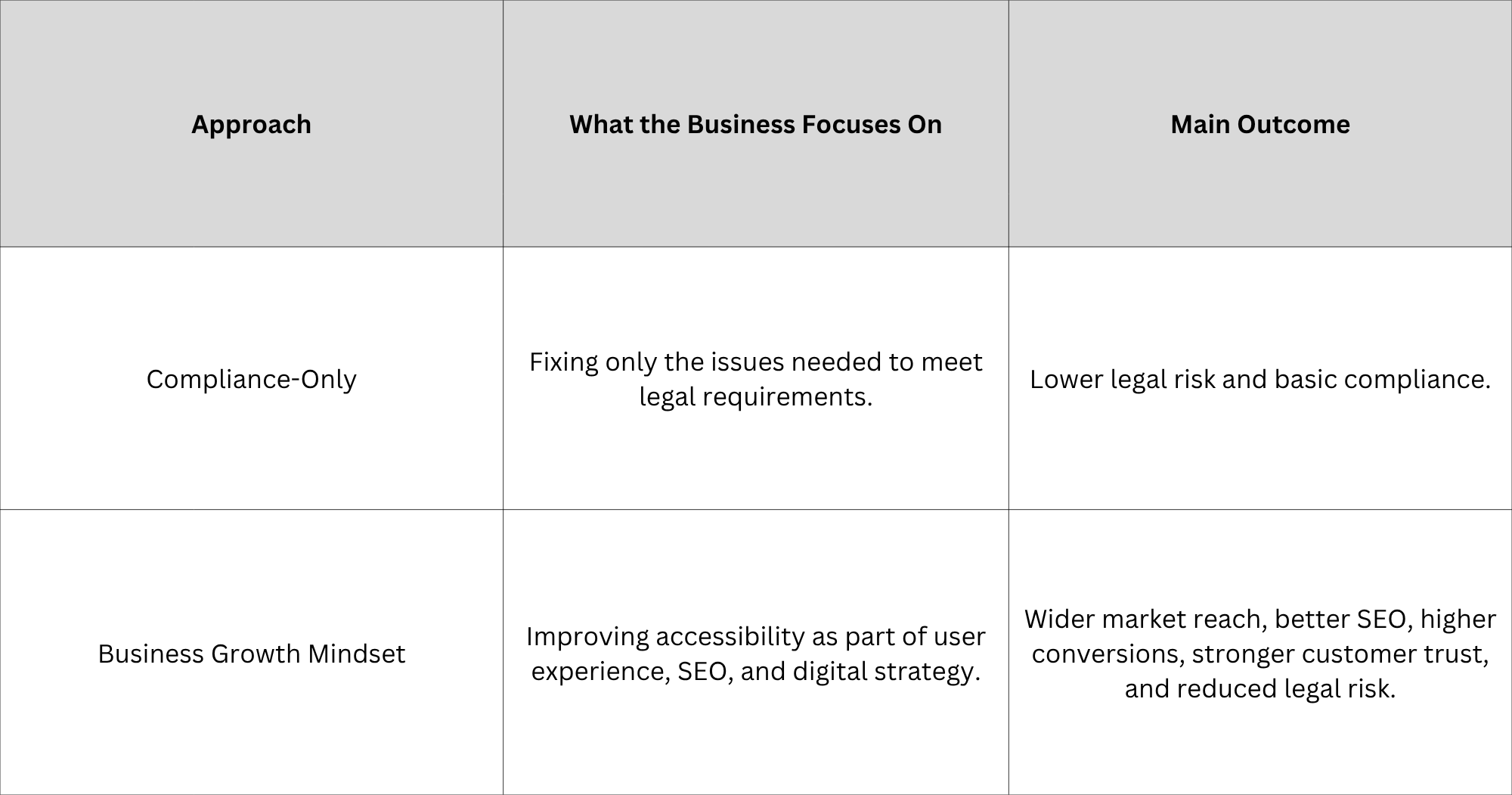
The difference is clear. A compliance-only approach helps protect the business, but a growth-focused approach helps the business improve its digital presence while also meeting accessibility requirements. Instead of seeing accessibility as an expense, businesses begin to view it as an investment that supports several goals at the same time.
How to Make Accessibility a Growth Lever
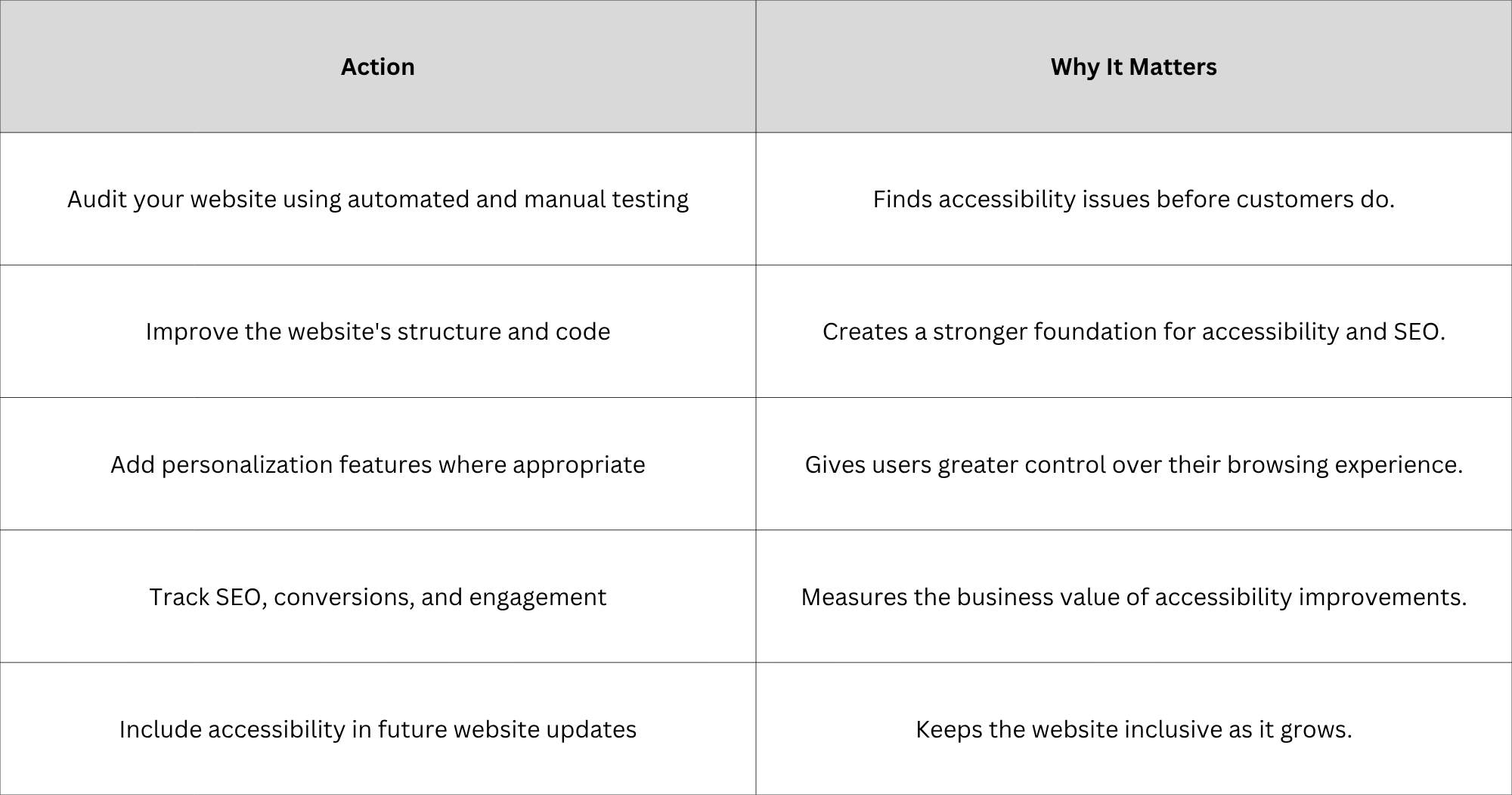
Building an accessible website does not always require a complete redesign. Many improvements can be introduced step by step as part of regular website updates. The important thing is to treat accessibility as an ongoing process instead of a one-time project.
The first step is to understand the current state of your website. This means carrying out an accessibility audit using both automated tools and manual testing. Automated tools can identify common issues, but real user testing provides a better understanding of how people interact with the website.
Next, improve the foundation of the website by using accessible code, proper heading structures, descriptive links, keyboard-friendly navigation, and meaningful alternative text for images. These changes make the website easier for assistive technologies, search engines, and everyday users to understand.
Some businesses also choose to add accessibility personalization features that allow visitors to adjust text size, colour contrast, spacing, or reading preferences. While these features are not a replacement for accessible development, they can provide additional flexibility for users with different needs.
Finally, measure the results. Track changes in organic traffic, user engagement, conversion rates, bounce rates, and customer feedback. These measurements help businesses understand the real impact of accessibility and identify new opportunities for improvement.
Accessibility-as-Growth Checklist
Conclusion
Accessibility should no longer be viewed as a task completed only to satisfy legal requirements. It is a practical business strategy that improves how people interact with a website while supporting growth in several areas at the same time. From reaching a wider audience and improving SEO to increasing conversions and building customer trust, the web accessibility business benefits extend far beyond compliance.
Businesses that invest in accessibility today are preparing for a digital future where inclusive experiences will become the standard rather than the exception. Instead of asking whether accessibility is required, the better question is how much value an accessible website can create for both customers and the business.
If your website already has an accessible foundation, solutions like AccessBit can add another layer of support through user personalization features that help visitors adjust their browsing experience to meet their individual needs. When accessible development and thoughtful personalization work together, businesses can create digital experiences that are more inclusive, more engaging, and better prepared for future growth.
Frequently Asked Questions
1 . Does web accessibility help SEO?
Yes. Accessibility improves many elements that search engines value, including clear headings, semantic HTML, descriptive image text, logical navigation, and well-organized content. While accessibility is not a direct ranking factor by itself, it creates a stronger technical foundation that supports better SEO and improves how search engines and AI systems understand your website.
2. What is the ROI of web accessibility?
The return on investment goes beyond compliance. Accessibility helps businesses reach a larger audience, improve search visibility, increase conversions, strengthen customer trust, and reduce legal risk. Because one investment supports multiple business goals, accessibility often delivers value over the long term.
3. How large is the accessibility market?
More than one billion people around the world live with some form of disability. When their families, caregivers, and close social networks are also considered, this represents one of the world's largest consumer markets with trillions of dollars in annual spending power. Businesses that ignore accessibility may miss the opportunity to serve this important audience.
4. Does accessibility improve conversions?
Yes. Accessibility removes barriers that make websites difficult to use. Clear navigation, readable text, accessible forms, captions, and better colour contrast help visitors complete important actions more easily. These improvements benefit all users, not just people with disabilities, often leading to higher conversion rates.
5. Is web accessibility worth it for small businesses?
Yes. Small businesses benefit from accessibility because it expands their potential customer base while improving website usability and search visibility. Many accessibility improvements are affordable, especially when they are included during regular website updates instead of being added later as major fixes.


