

Subscribe to AccessBit Newsletter
Accessibility


TL;DR
- SEO accessibility means making websites easy for both users and search engines to understand and navigate.
- Accessible websites naturally improve structure, readability, crawlability, mobile usability, and overall UX.
- Many accessibility improvements also strengthen SEO through better engagement and technical quality signals.
- SEO and accessibility overlap through semantic HTML, clear hierarchy, descriptive content, and inclusive design.
- The goal is not only compliance or rankings but also building usable, discoverable, and trustworthy digital experiences.
The connection between SEO and accessibility is growing increasingly stronger as we enter 2026 than ever before. Earlier, SEO focused exclusively on search ranking and traffic, while accessibility worked to help people with disabilities access the information provided on the web.
With time, as technology has advanced, this separation has become impractical. The complexity of the World Wide Web has increased; users are accessing the Web from multiple devices; search engines are no longer evaluating only the content of a website based on the use of keywords or backlinks but are including many other factors, such as website structure and usability, site readability, and overall user experience, when determining the position of a web page in their search engine listings.
As a result of all of this, SEO and accessibility have come to overlap very naturally. A website that is well structured makes it easier for a user to find their way around and therefore much easier for a search engine to understand. Conversely, if a website is poorly structured and organized, it will likely perform poorly in both areas.
SEO accessibility consists of the many components of both disciplines under one methodology that includes the development of websites that can be discovered, are usable, readable, and accessible by all users. In this blog we will explore everything we need to know about SEO and accessibility. Let’s dive in.
What Is SEO Accessibility?
SEO accessibility can be described as the process of maximizing both SEO capabilities and website accessibility. Rather than treating SEO and accessibility as two different approaches, SEO accessibility seeks to combine both because, ultimately, they serve the same purpose, making sure content is accessible to users in the most effective way possible.
In order to grasp this concept, we have to start by understanding SEO and accessibility as individual concepts.
Understanding SEO
SEO (search engine optimization) refers to a practice where one improves their site to allow for higher visibility through search engines. Here, the goal is to ensure visibility; users should find one's web page when searching through search engines.
In the past, SEO was concentrated more on technical elements and keywords. Optimization involved working on metadata, backlinking, targeting keywords, and indexing, among other processes. Although all these practices are still part of today's SEO, this field has changed greatly in recent years.
Currently, search engines do not just check whether the web pages have relevant keywords. They also analyze the usability of the content based on several criteria. These include usefulness, readability, and real-world performance.
This means that besides ensuring that one's page ranks highly, one must also ensure that the web page delivers value for users.
The above clearly shows how SEO ties up with accessibility because most of the criteria used by search engines are associated with accessibility.
Understanding Accessibility
By the term "accessibility," one can understand the creation of web pages and services in a certain manner to ensure that the use of these is possible for individuals having different abilities and conditions. For example, this may include users with physical disabilities but also users who are experiencing different situational difficulties like poor lighting or low bandwidth.
The key idea of accessibility is ensuring that nobody is prevented from accessing information because of some barriers created by the design of the page or service. A person using a screen reader is expected to browse content logically. A user operating a website using a keyboard should experience no problems interacting with content. A person visiting the site from a mobile device should not face any problems reading and interacting with the content as well.
It is important to note here that making the website accessible makes its use easier not only for people with disabilities but for other visitors as well. It increases readability, facilitates navigation, and reduces eye strain.
Where SEO and Accessibility Overlap?
The overlap between SEO and accessibility lies in the fact that both disciplines require structured content and understanding of its meaning. The algorithms of search engines do not work with visual aspects of websites and use structure for interpreting pages' content. Similarly, accessible websites also require certain structured elements for assisting people with disabilities in navigating and understanding webpages.
As a result, there is a close connection between the two types of optimization. Accessibility optimization of a webpage will automatically lead to better results in terms of SEO.
An important example of this intersection is headings, which are used by screen readers as navigational elements allowing jumping from one section to another and also help search engines in identifying what topics a website or page is devoted to. Thus, an optimal system of headings contributes to both usability and search engine optimization.
Images also prove the point. The usage of alt text provides people who use screen readers with additional information about images' meaning but also gives necessary context for search engines when processing and interpreting them.
Another aspect in which accessibility and SEO have much in common is semantic HTML usage. When used correctly, proper header tags, navigation bars, article elements, and footers help screen readers comprehend website structures more effectively. Simultaneously, it will make content sections easier to comprehend and evaluate by search engines.
Readability is yet another element where SEO and accessibility intersect. Well-written and well-structured content will be easily comprehended by both people and search engine algorithms. Lengthy and convoluted sentences together with poor formatting can lead to decreased user engagement, and thus influence SEO results negatively.
Mobile responsiveness and page speed are two other aspects in which accessibility and SEO coincide. Responsive design and faster loading pages improve user experience, especially considering users with visual impairments, when used on different types of devices with various connection speeds. At the same time, those are two elements that have a significant impact on SEO ranking algorithms in the modern world.
Overall, the connection between accessibility and SEO relies on one core concept, lowering friction.
SEO vs Accessibility vs SEO Accessibility
Although SEO and accessibility overlap significantly, they still serve distinct purposes. Understanding these differences helps clarify why combining them creates stronger results.
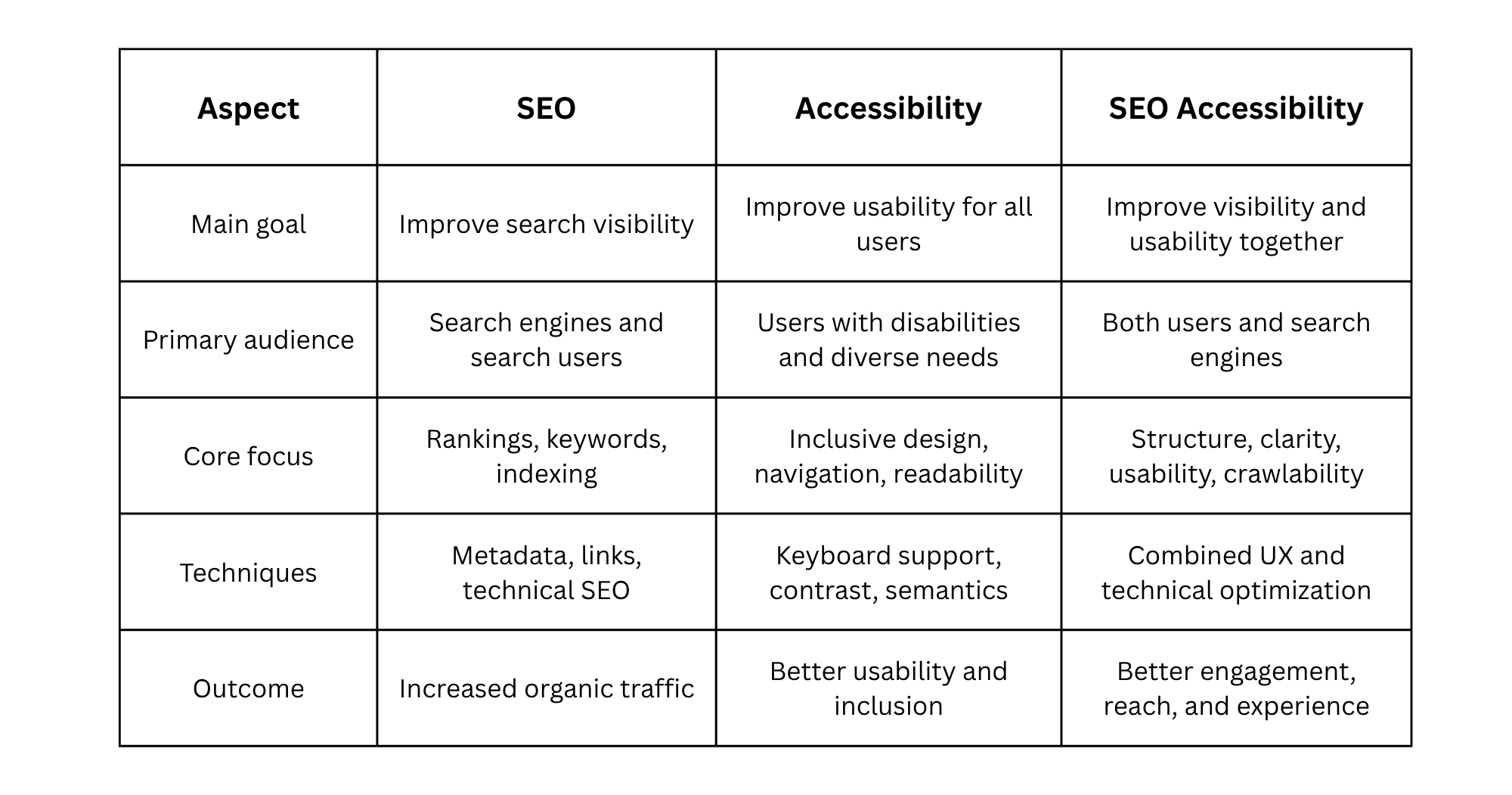
SEO focuses on making content discoverable through search engines. Accessibility focuses on making content usable for all people regardless of limitations. SEO accessibility brings these together by ensuring that content is both discoverable and usable at the same time.
Why SEO and Accessibility Go Hand in Hand
The link between accessibility and SEO becomes clear when you consider the fact that search engines are becoming more and more focused on user experience. A page that is designed with user experience in mind will not only be easier to rank but will actually attract more user activity.
Modern search engines do more than merely match search queries with keywords. Search engines are looking at whether users actually benefit from visiting a particular page and having certain content available. This makes web accessibility improvements very important for SEO purposes since they simplify navigation and make information easier to perceive.
This point could be illustrated by such a practice as the use of heading tags. On one hand, using the correct heading structure allows users to scan the page much faster; on the other hand, it helps search engines to understand how information should be perceived.
A good example of such practice is creating an accessible menu. Such menus allow users to access necessary information much quicker and give search engines more opportunities to crawl the page and analyze its structure.
In 2026, this relationship has become even more significant due to the increasing volume of online content. With more competition and more AI-generated pages, search engines are relying more heavily on quality signals such as clarity, structure, and usability. Accessibility naturally strengthens all of these areas, which is why it plays an increasingly important role in SEO strategy.
What Are the Best Practices in SEO Accessibility?
Below are some of the best practices in SEO accessibility:
1. Semantic HTML: The use of proper HTML markup, including elements such as headings, sections, navigation, and article, makes it easier for accessibility and crawlers to comprehend the structure of web content. This will make navigation easy for users and more comprehensible for crawlers.
2. Hierarchical Headings: An effective hierarchy of headings (H1, H2, H3, and so forth) makes scanning much easier for the users. At the same time, it allows search engines to determine the significance of various topics and their interconnections.
3. Alt Text Description: Appropriate alt-text descriptions offer helpful information for users that are not able to perceive images. Moreover, this description enables the search engine to recognize what exactly the picture is. Proper writing will enhance accessibility and image SEO.
4. Meaningful Anchor Text: Applying descriptive text for links is more helpful than phrases such as "Click Here" for users and makes the link clearer for crawlers.
5. Responsiveness: A website that is responsive in design will adapt to various platforms like smartphones, laptops, tablets, and others. This not only enhances the experience for actual users but is also required by the algorithm for mobile-first indexing.
6. Page Load Time: The quick load times of pages ensure an excellent browsing experience for all users irrespective of whether they have a slow network connection or old devices. This is a critical SEO component.
7. Language Clarity: Use of language that is easily comprehensible and organized ensures enhanced accessibility for everyone, including those who cannot understand English fluently.
Benefits of SEO Accessibility
SEO accessibility provides several practical advantages that directly improve both user experience and search engine performance. The following are some of the key benefits that highlight its importance in modern web development.
1 . Improves overall user experience across devices and conditions
SEO accessibility makes websites easier to read, navigate, and interact with by focusing on clarity, structure, and usability. When content is well-organized and accessible, users can find information faster without unnecessary effort, whether they are on mobile, desktop, or assistive technologies.
2. Strengthens SEO performance indirectly through engagement signals
While accessibility is not a direct ranking factor, it improves behaviors that search engines measure, such as time on page, bounce rate, and interaction quality. When users can comfortably consume content, they are more likely to stay longer and explore deeper.
3. Improves crawlability and content understanding for search engines
Accessible structure, such as proper headings, semantic HTML, and descriptive elements helps search engines interpret page content more accurately. This leads to better indexing and clearer understanding of topical relevance.
4. Expands audience reach and inclusivity
SEO accessibility ensures websites work for users with disabilities, older devices, slow internet connections, or temporary limitations. This broader usability increases the potential audience size and makes content more universally available.
5. Supports long-term scalability and maintainability
When websites follow consistent accessibility and structural standards, content becomes easier to update, manage, and scale. This reduces technical debt and improves long-term efficiency for teams managing large sites.
6. Builds trust and improves perceived quality
Users often associate well-structured, accessible websites with professionalism and credibility. A clean, readable, and easy-to-use interface creates a stronger brand impression and encourages return visits.
Common Mistakes to Avoid
While SEO accessibility offers many advantages, it is often not implemented correctly. The following are some of the most common mistakes that reduce its effectiveness and should be avoided when optimizing a website.
1 . Treating accessibility and SEO as separate final-stage tasksMany teams try to “add accessibility later” after design or development is complete. This usually results in incomplete implementation and missed opportunities. Both should be built into the workflow from the beginning.
2. Overusing keywords at the cost of readabilityWriting content that is heavily optimized for keywords but difficult to read reduces both accessibility and engagement. Modern SEO requires natural, clear language that prioritizes user understanding.
3. Ignoring or misusing alt text for imagesA common mistake is leaving images without alt text or stuffing them with repetitive keywords. Proper alt text should describe the image meaningfully so both users and search engines can understand it.
4. Using poor color contrast and visually heavy layoutsLow-contrast text or overly complex designs make content harder to read, especially on mobile devices or in bright environments. This directly impacts accessibility and user comfort.
5. Weak or inconsistent heading structureSkipping heading levels or using headings only for styling breaks content hierarchy. This confuses screen readers and also makes it harder for search engines to understand page structure.
6. Over-reliance on non-semantic HTML elementsUsing generic elements instead of semantic tags reduces clarity in page structure. This affects both accessibility tools and search engine interpretation of content relationships.
7. Poor mobile optimizationWebsites that do not adapt properly to mobile screens often require zooming, horizontal scrolling, or excessive scrolling. This creates friction for users and negatively impacts SEO performance.
8. Using unclear or generic link textAnchor text like “click here” or “read more” provides no context. Descriptive link text improves navigation for users and also helps search engines understand link relevance more accurately.
How to Improve SEO Accessibility on Your Website
Improving SEO accessibility usually begins with auditing existing content and structure. This includes reviewing headings, checking image descriptions, analyzing navigation flow, and evaluating readability across different pages.
From there, improvements can be made by refining templates so that consistent semantic structure is used across the entire website. This ensures that accessibility and SEO improvements are applied uniformly rather than inconsistently across pages.
Content formatting also plays an important role. Shorter paragraphs, clearer headings, and structured sections improve readability and make content easier to scan.
Testing is another important step. Websites should be checked using keyboard navigation, mobile devices, and accessibility tools to ensure that all users can interact with content without friction.
Finally, accessibility and SEO should be considered during every stage of publishing rather than after content is already live. This creates a more consistent and scalable approach over time.
Conclusion
SEO and accessibility are no longer distinct fields in modern web development. They are inextricably linked approaches that seek to improve how people discover, understand, and use digital content.
In 2026, high-performing websites are not only optimized for search engines but also for real-world human interaction across various devices, abilities, and browsing conditions. SEO accessibility combines these concepts by ensuring that content is discoverable and usable at the same time.
If you want to learn more about how SEO and accessibility can work together to improve your website or how to implement accessibility tools like AccessBit in your business, please contact us.
Frequently Asked Questions
1 . Does accessibility help SEO?
Indeed, accessibility frequently has an indirect positive impact on SEO. Many accessibility enhancements improve usability, readability, and structure, all of which search engines take into account when assessing the quality of a page.
2. Is accessibility part of SEO?
They overlap a great deal, but not directly. While SEO concentrates on search visibility, accessibility prioritizes usability for all users. Both are supported concurrently by many practices.
3. What is SEO accessibility?
SEO accessibility is the practice of optimizing websites so they are both search-engine friendly and usable for all users, combining principles from SEO, UX, and accessibility design.
4. Can accessibility improve rankings?
No. Accessibility does not directly influence rankings, but it can improve user experience signals such as engagement and usability, which indirectly support SEO performance.
5. What are examples of SEO accessibility improvements?
Some examples of SEO accessibility improvements include semantic HTML structure, descriptive alt text, proper heading hierarchy, mobile responsiveness, readable content, and fast page loading speed.


